

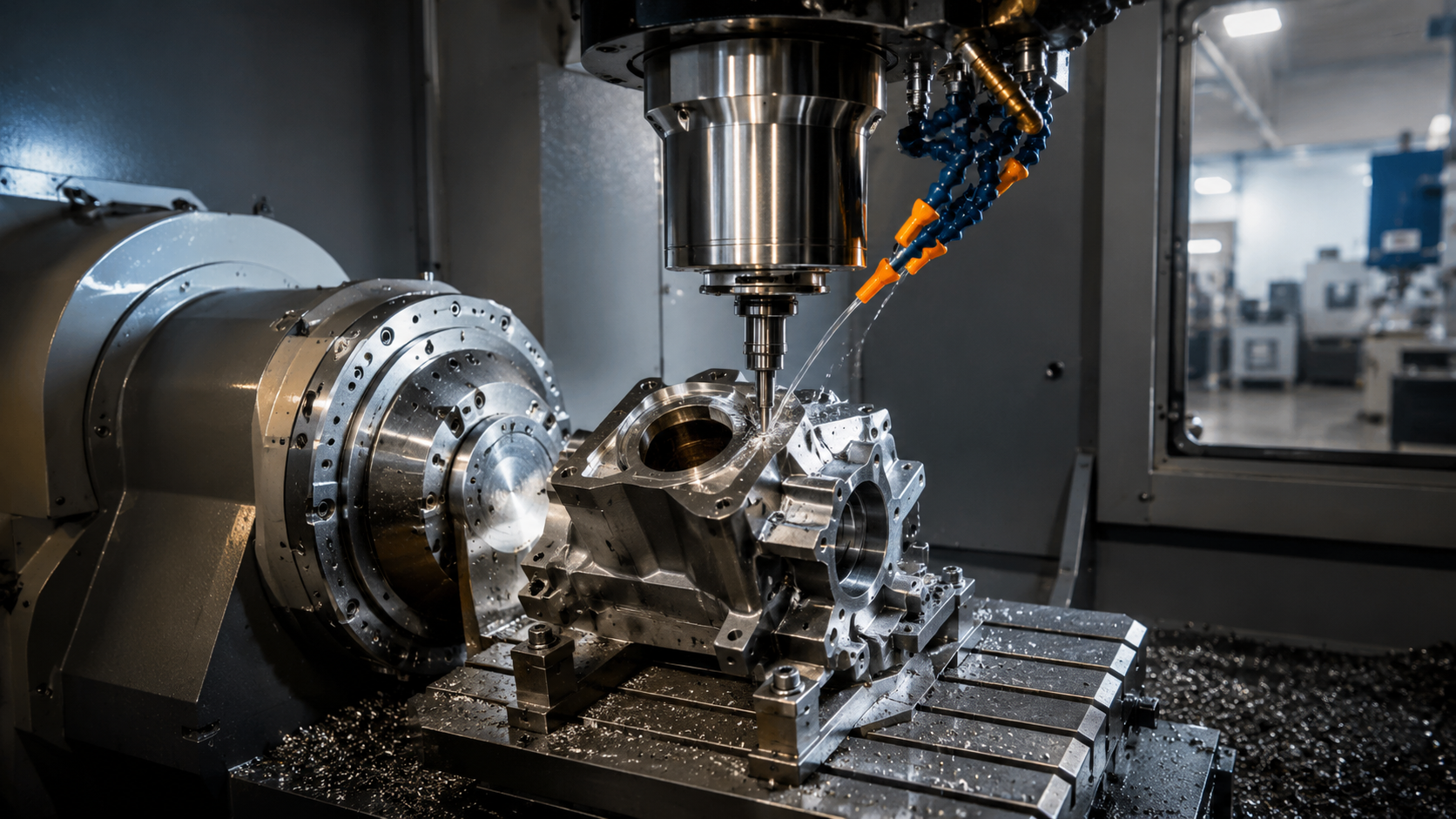
Modern manufacturers need components that are accurate, repeatable and produced within demanding delivery schedules. This is where 4-axis CNC machining provides a major advantage. By adding a rotary axis to conventional CNC machining, manufacturers can machine multiple sides of a component with fewer setups, improving accuracy while reducing production time.
As an Australian engineering company, Gaja Engineering provides precision engineering solutions designed to meet the requirements of industries that depend on reliable, high-quality machined components.
What Is 4-Axis CNC Machining?
4-axis CNC machining uses an additional rotary axis alongside the conventional X, Y and Z axes. This allows the workpiece to be rotated during machining, enabling multiple faces and complex features to be manufactured with fewer manual repositioning operations.The result is improved dimensional consistency, reduced setup time and greater production efficiency for suitable components.
How Does 4-Axis CNC Machining Improve Accuracy?
One of the biggest benefits of 4-axis machining is reduced workpiece repositioning.
With conventional machining, a component may need to be removed, manually repositioned and secured again to machine another side. Every additional setup creates an opportunity for alignment errors.
A 4-axis CNC machine can rotate the component accurately while maintaining the programmed machining process. This helps manufacturers achieve tighter consistency between features and across production batches.
For precision CNC machining for Australian manufacturers, fewer setups can mean better repeatability and more reliable component dimensions.
How Does 4-Axis Machining Increase Production Efficiency?
Production efficiency is not simply about machining faster. It is also about reducing non-machining time.
4-axis CNC machining can reduce:
- Workpiece repositioning
- Manual setup time
- Tool-change interruptions
- Alignment procedures
- Handling between operations
This makes the process particularly useful for CNC machining for complex metal components, where several faces require drilling, milling, grooving, tapping or contouring.
For repeat production, these time savings can contribute to shorter manufacturing cycles and more predictable lead times.
Why Is 4-Axis CNC Useful for Complex Components?
Modern engineering components often include multiple holes, angled features, pockets, grooves and contoured surfaces.
A 4-axis machine can provide greater machining flexibility by rotating the workpiece to access different surfaces. This can reduce the need for separate fixtures or multiple machining operations.
For businesses looking for high-precision CNC machining services in Australia, this capability can make complex components more practical to manufacture while maintaining consistent quality.
How Can 4-Axis CNC Reduce Manufacturing Costs?
Reducing cost does not always mean using the cheapest machining process. Efficient production can lower the overall cost per component.
Fewer setups, reduced handling and improved repeatability can help reduce labour requirements and production delays. For larger production runs, these efficiencies can become increasingly valuable.
The exact cost benefit depends on the component design, material, quantity, tolerances and machining requirements.
Why Choose Gaja Engineering for CNC Machining?
Gaja Engineering combines CNC machining capability with practical engineering knowledge to support Australian manufacturing requirements.
Our CNC machining solutions are suitable for components requiring accuracy, repeatability and efficient production. Whether you require prototype components, replacement parts or repeat production, discussing the component requirements early can help identify the most efficient manufacturing approach.
Conclusion :
4-axis CNC machining can provide a practical combination of accuracy, repeatability and production efficiency. By reducing setups and allowing multiple features to be machined more efficiently, it can help manufacturers produce complex components with greater consistency.
If your business is looking for 4-axis CNC machining services in Adelaide or precision CNC machining support in Australia, Gaja Engineering can help assess your component requirements and identify an appropriate machining solution.
Found this guide useful? Share it with your engineering, procurement or manufacturing team. Have experience with 4-axis machining or a question about your component requirements? Leave your feedback or contact Gaja Engineering to discuss your next project.
Frequently Asked Questions (FAQ)
1. What is 4-axis CNC machining?
4-axis CNC machining is a computer-controlled manufacturing process that uses X, Y, Z and an additional rotary axis to machine multiple surfaces of a component with fewer setups.
2. Is 4-axis CNC machining more accurate?
It can improve accuracy and repeatability by reducing the number of times a workpiece needs to be manually repositioned between machining operations.
3. What are the main benefits of 4-axis CNC machining?
The main benefits include improved repeatability, fewer setups, reduced handling, greater machining flexibility and improved production efficiency.
4. What materials can be machined using 4-axis CNC?
Depending on the machine and tooling, 4-axis CNC machining can be used for materials such as aluminium, steel, stainless steel, brass, alloys and various engineering metals.
5. When should a manufacturer choose 4-axis CNC machining?
4-axis CNC machining is particularly useful when a component has features on multiple faces, complex geometry or production requirements that would benefit from fewer setups.
6. Where can I find 4-axis CNC machining services in Adelaide?
Australian manufacturers can work with engineering companies such as Gaja Engineering to discuss component design, material, tolerances, quantities and machining requirements.

